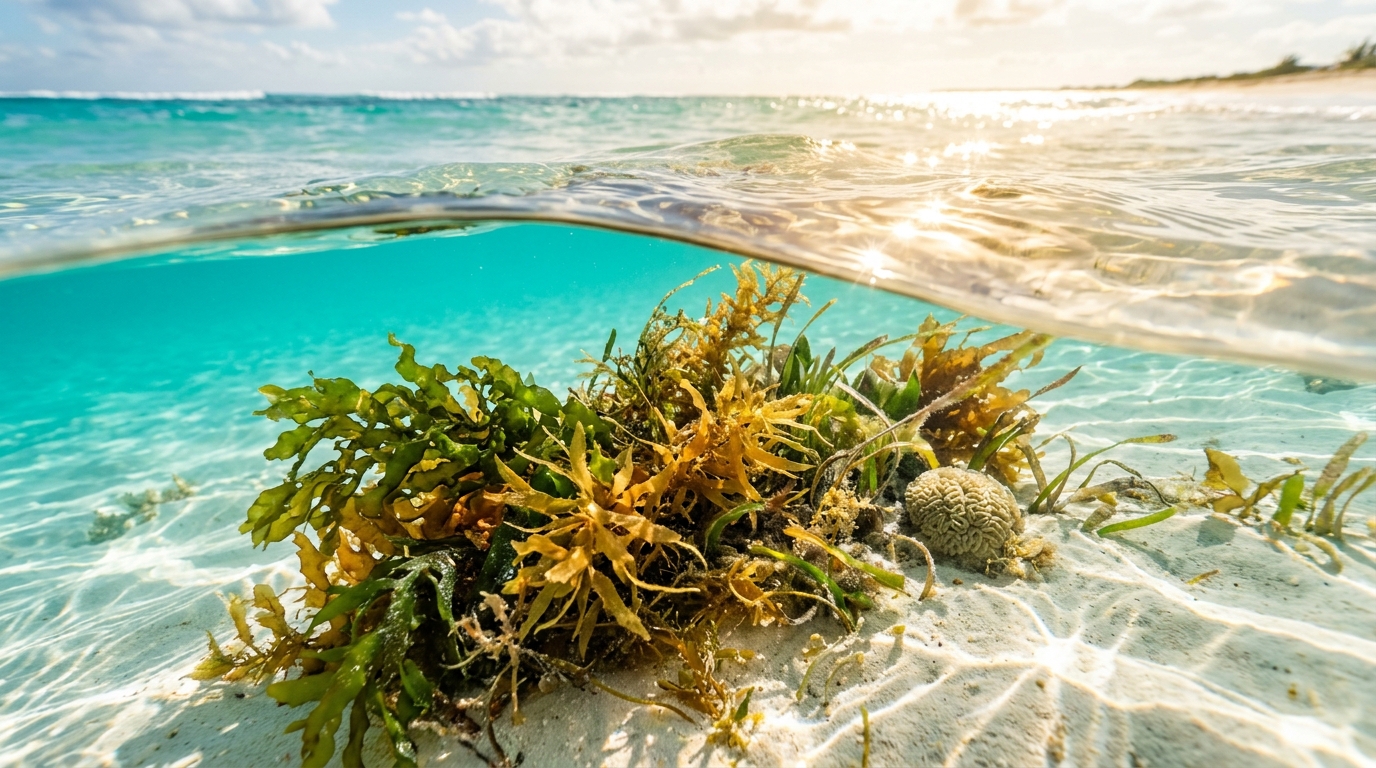
Every summer across the wider Caribbean, millions of metric tons of pelagic Sargassum macroalgae wash ashore along turquoise coastlines. For municipal authorities and coastal hospitality operators, these massive golden-brown blooms have historically been treated as an acute financial burden—costing the region over $120 million annually in emergency beach clearing, heavy equipment removal, and landfill disposal.
The Paradigm Shift: From Coastal Burden to Raw Industrial Feedstock
Viewing Sargassum solely as marine waste represents an outdated linear perspective. In reality, pelagic Sargassum represents an abundant, self-replenishing supply of organic biochemicals, minerals, and structural polymers delivered directly to our shores by prevailing equatorial currents.
Across leading Caribbean research institutions—most notably at the University of the West Indies (UWI) Cave Hill and regional biotechnology pioneers—scientists and chemical engineers are proving that macroalgae biomass can be fractionated into commercial compounds that replace expensive foreign imports across agriculture and packaging.
Biochemical Refining: Sodium Alginate & Organic Nutrients
Raw Sargassum contains high concentrations of potassium, nitrogen, trace micronutrients, and complex structural carbohydrates, primarily alginates and fucoidans.
Through controlled thermo-chemical pre-treatment and enzymatic digestion, modern bio-refineries separate the raw seaweed into two high-value industrial streams:
- Liquid Organic Biostimulants: High-potency plant stimulants and foliar sprays that accelerate root development, enhance drought resistance in tropical crops, and reduce reliance on synthetic petroleum-derived fertilizers.
- Sodium Alginate Polymers: Natural biopolymer matrices that can be dried and molded into water-soluble film barriers, single-use compostable food packaging, and agricultural seedling trays—providing a 100% biodegradable alternative to single-use plastics.
“Island resilience is built on the ability to turn external vulnerabilities into productive domestic capability. Sargassum is not an environmental defeat; it is an unharvested natural resource for the Caribbean bio-economy.”
Engineering Purity: Overcoming the Heavy Metal Challenge
A critical consideration in Sargassum processing is the natural bioaccumulation of heavy elements, notably arsenic and cadmium, absorbed by the seaweed during its transatlantic drift. Early, unscientific attempts to dump raw seaweed directly onto farm soil risked contaminating ground crops.
Modern commercial bio-fractionation solves this through proprietary chelating agents and bio-sorption filtering. By separating heavy elements from the pure carbohydrate and nitrogen fractions, processors produce laboratory-certified biostimulants that meet strict international agricultural safety standards (including USDA Organic and EU regulations).
- Tourism Protection & Waste Diversion: Off-shore and beachfront harvesting protects resort shorelines while diverting thousands of tons from local municipal waste streams.
- Domestic Fertilizer Security: Supplies regional farmers and commercial hydroponic facilities with local, cost-effective bio-nutrients, insulating food production from global supply chain shocks.
- Plastic Replacement: Creates localized manufacturing capacity for biodegradable packaging, directly supporting national single-use plastic reduction policies.
Building a Regenerative Caribbean Blue Economy
The Caribbean's geographic vulnerability to ocean currents is also its competitive advantage. By establishing centralized, standards-compliant seaweed processing infrastructure, island nations can transform an annual ecological disruption into an exportable, high-margin bio-manufacturing sector that protects shorelines while building multi-generational economic resilience.
- University of the West Indies (UWI Cave Hill): Department of Biological and Chemical Sciences research on sodium alginate extraction and bioplastic barrier films from pelagic Sargassum fluitans.
- Caribbean Regional Fisheries Mechanism (CRFM) & FAO: Regional Sargassum Management and Valorization Strategy for sustainable blue economy development across CARICOM.
- CARICOM "25 by 2025" Food Security Framework: Policy directives integrating localized bio-fertilizer production to reduce Caribbean agri-food import bills by 25%.