In tropical island economies, thermal comfort is the single largest consumer of electrical energy. Across luxury resorts, commercial airports, data facilities, and hospitals, conventional vapor-compression air conditioning accounts for 60% to 70% of total baseline electrical load. In archipelagos reliant on imported diesel fuel, this creates astronomical utility tariffs exceeding $0.40 to $0.55 per kilowatt-hour.
Global Precedent: How Bora Bora Pioneered Deep Ocean Cooling
While conventional engineering attempts to solve cooling by building larger solar arrays to power inefficient rooftop compressors, a fundamentally more elegant physical solution exists directly off island shores: Seawater Air Conditioning (SWAC).
In French Polynesia, the InterContinental Bora Bora Resort & Thalasso Spa pioneered commercial SWAC in 2006 by laying a deep-water intake pipe descending 914 meters (3,000 feet) into the South Pacific. At that depth, ocean water remains perpetually chilled at 4°C (39°F), fed by sub-polar deep currents.
By drawing this cold water through a closed-loop titanium heat exchanger, the resort completely bypassed mechanical chillers—reducing electricity consumption for air conditioning by over 90% and eliminating 2.5 million liters of imported fuel consumption every year for nearly two decades.
Thermodynamics & Closed-Loop Marine Cooling Architecture
The physics of SWAC are remarkably straightforward and non-polluting:
- Cold Water Intake: High-density polyethylene (HDPE) pipelines draw 4°C to 5°C seawater from depths of 700 to 1,000 meters.
- Heat Transfer Interface: The deep seawater passes through corrosion-resistant plate-frame titanium heat exchangers located at an onshore pumping station. Cold thermal energy is transferred directly into an internal freshwater distribution loop.
- District Distribution: The chilled freshwater (circulating at 6°C to 7°C) flows through insulated underground piping into resort villas and commercial air handlers, cooling indoor spaces without compressors or synthetic fluorocarbon refrigerants.
- Pure Marine Return: The seawater, slightly warmed to 10°C to 12°C during heat exchange, is returned safely to intermediate ocean depths, having never come into chemical contact with any industrial substance.
“The greatest infrastructure breakthroughs in island geography work with nature's deep physical contours rather than against them. Deep ocean cooling replaces costly mechanical brute force with perpetual thermodynamic harmony.”
The Submarine Advantage: Turks & Caicos Bathymetric Profile
Why is this proven technology extraordinarily compelling for the Turks & Caicos Islands?
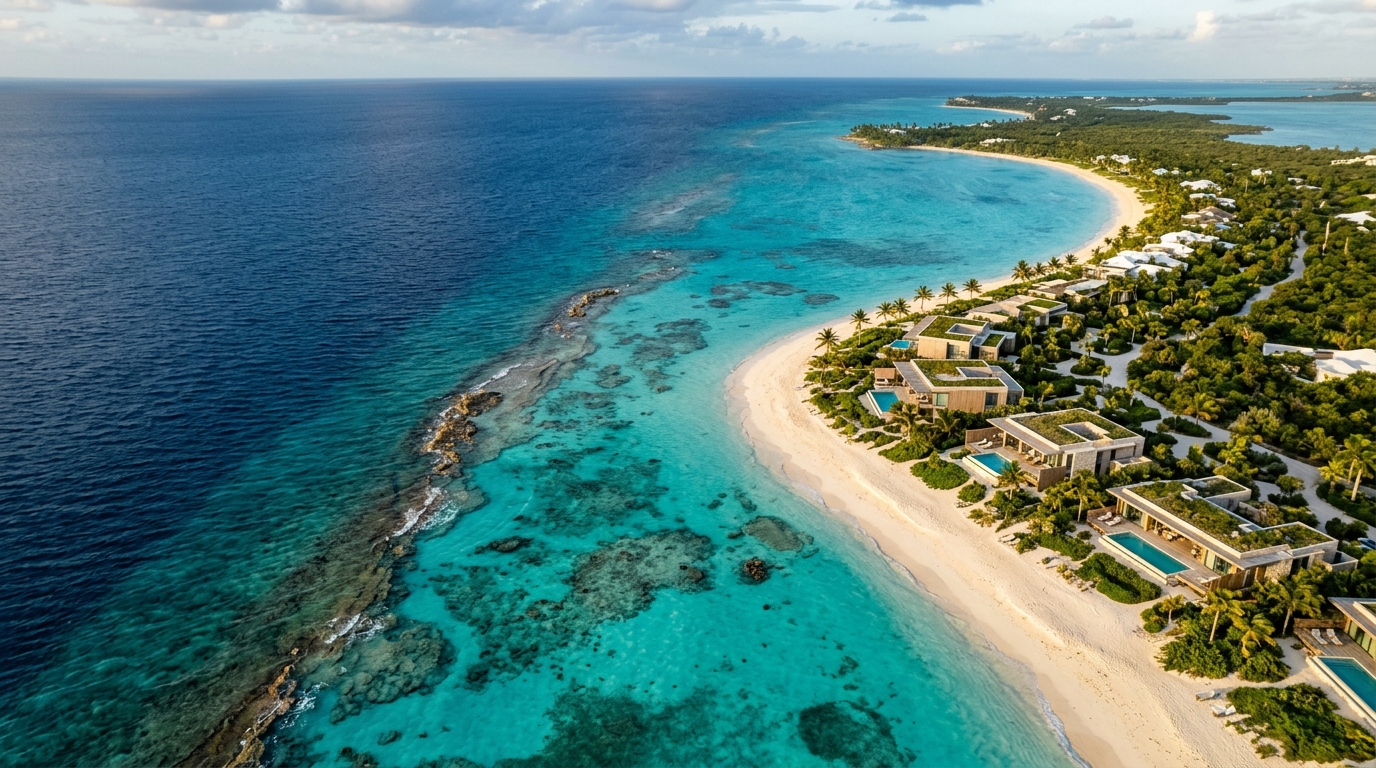
Unlike shallow continental coastlines where cold water lies dozens of miles offshore, the Turks & Caicos archipelago sits atop steep limestone submarine platforms. Immediately adjacent to Providenciales, West Caicos, and Grand Turk, the ocean floor plunges abruptly into the Columbus Passage and the Atlantic abyssal plain, reaching depths exceeding 1,000 to 2,000 meters within just a few kilometers of the shoreline.
This unique bathymetry dramatically reduces the capital expenditure and pipeline distance required for deep-water intake, creating prime conditions for district cooling hubs serving clustered resort corridors and future infrastructure master-plans.
- 85%–90% Peak Load Reduction: Eliminates the heaviest electrical demand on island power grids, slashing operational overhead for commercial enterprises.
- Zero Chemical Refrigerants: Completely removes HFCs and greenhouse gases associated with conventional refrigerant leaks and compressor failures.
- Insulation From Fuel Volatility: Replaces fluctuating diesel fuel surcharges with a predictable, perpetual renewable cooling utility.
Generational Infrastructure for Island Self-Reliance
As island economies confront rising energy demands and coastal climate realities, investing in subterranean deep-ocean cooling transforms a recurring operational cost into permanent utility infrastructure. By harnessing the cold abyss beneath our waters, island communities can achieve unprecedented levels of energy self-reliance, environmental purity, and multi-generational economic resilience.
- World Bank & ESMAP Ocean Thermal Studies: Technical and Economic Feasibility of Deep Seawater Air Conditioning (SWAC) in Caribbean and Small Island Developing States.
- Bora Bora SWAC Operational Benchmark (French Polynesia): Longitudinal 18-year performance data on titanium heat exchangers and 90% electrical load displacement at InterContinental Thalasso.
- National Oceanic and Atmospheric Administration (NOAA) Bathymetric Data: Deep ocean trench depth profiles and Atlantic abyssal thermal gradients across the Turks & Caicos submarine platform.