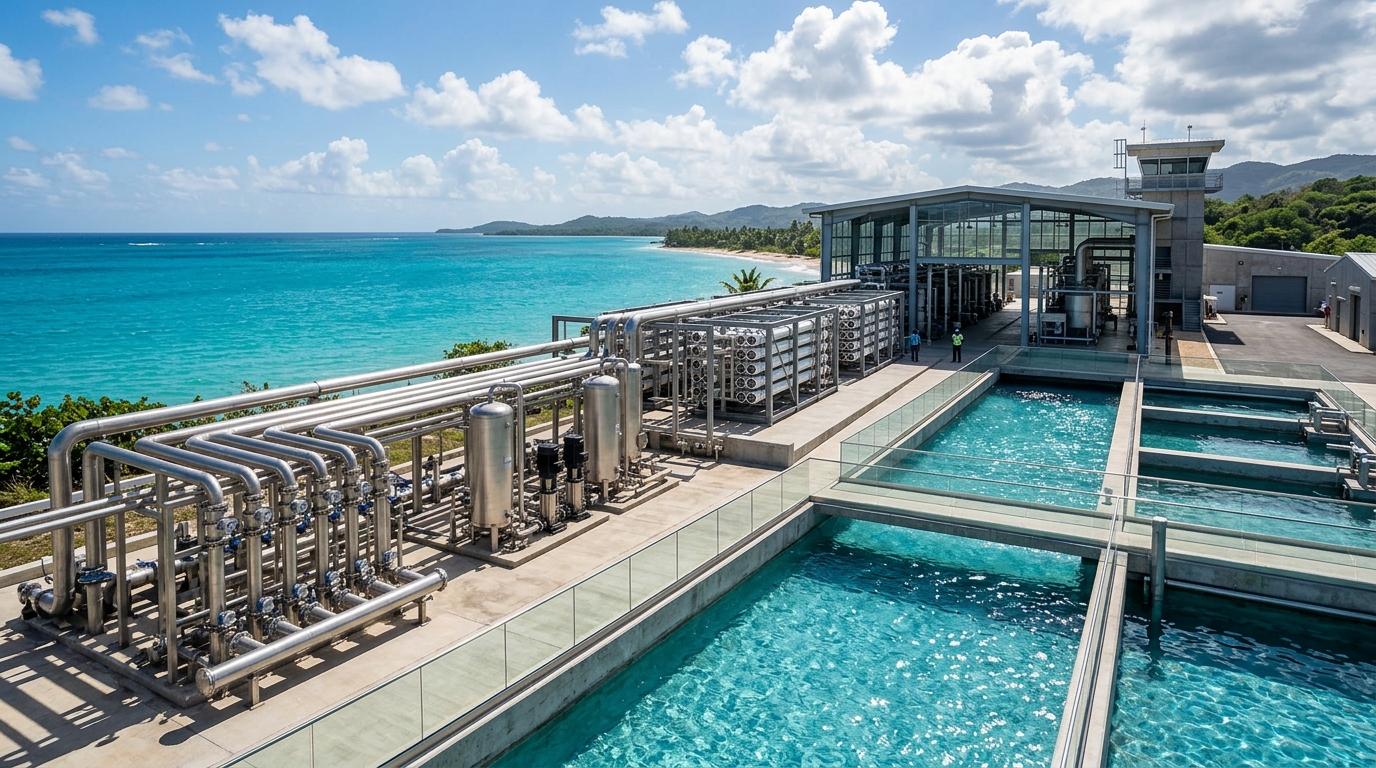
For small island developing states (SIDS) and low-lying archipelagos like the Turks and Caicos Islands, freshwater is among the most precious and energy-intensive commodities. With thin freshwater lenses and absent river systems, municipalities and private developments rely heavily on Seawater Reverse Osmosis (SWRO). Yet once consumed, vast quantities of this expensive water are discharged as wastewater rather than captured and cycled.
The Linear Water Dilemma on Isolated Grids
Traditional utility models treat water as a single-pass resource: extract seawater, desalinate it using grid electricity, pipe it to buildings, collect sewage, and discharge partially treated effluent into deep disposal wells or outfalls. In addition to wasting valuable energy, deep-well injection in porous karst limestone risks contaminating shallow groundwater lenses and sensitive nearshore coral ecosystems.
According to the United Nations Environment Programme (UNEP) and UNIDO technology assessments, decentralized closed-loop systems—such as advanced Membrane Bioreactors (MBR) and decentralized greywater recyclers—can purify greywater and domestic sewage to high non-potable standards, allowing up to 90% or more of water volume to be safely reused on-site for landscape irrigation, commercial laundry, cooling towers, and toilet flushing.
“In an island environment where freshwater requires heavy electrical generation to produce, treating wastewater as a single-use disposal problem is an economic inefficiency. Water must be managed as a continuous local cycle.”
Decentralized Reclamation Technologies
Modern reclamation infrastructure has evolved past massive municipal treatment works that require miles of underground gravity sewer networks. High-efficiency decentralized units offer immediate advantages:
- Membrane Bioreactor (MBR) Packages: Compact modular units that combine biological degradation with micro-filtration membranes, producing crystal-clear effluent exceeding WHO non-potable standards for resort grounds and residential estates.
- Engineered Subsurface Wetlands: Nature-based solutions utilizing gravel beds and native emergent vegetation that treat wastewater with near-zero energy consumption, creating aesthetic green spaces.
- Autonomous Point-of-Use Greywater Recyclers: Compact systems installed in individual villas or commercial laundries that treat sink, shower, and laundry drainage instantly for toilet refilling and exterior irrigation.
Economic and Environmental Dividends
By reducing peak demand on centralized SWRO utilities, widespread closed-loop integration delivers compounding economic resilience:
- Reduced Energy & Utility Costs: Treating greywater requires significantly less kilowatt-hours per cubic meter than producing fresh desalinated water from high-salinity seawater.
- Reef & Aquifer Protection: Eliminates nutrient-rich discharge into sensitive marine habitats, preserving the coral barriers that protect coastlines from storm surge.
- Landscape and Food Security: Provides guaranteed, drought-proof irrigation for local agriculture, nurseries, and botanical resort gardens even during extended dry seasons.
- High Volume Cycling: Reclaims up to 90%+ of domestic wastewater for irrigation and secondary utility demands.
- Energy Displacement: Significantly lowers per-gallon energy requirements compared to primary seawater reverse osmosis.
- Coastal Ecology Shield: Protects nearshore marine clarity and fragile coral reefs from nutrient enrichment.
- United Nations Industrial Development Organization (UNIDO): Decentralized Water Reclamation and Circular Utility Systems in SIDS.
- World Health Organization (WHO): Guidelines for the Safe Use of Wastewater, Excreta and Greywater in Agriculture and Aquaculture.
- International Desalination Association (IDA): Energy Consumption Comparisons: Wastewater Recycling vs. High-Recovery Seawater Desalination.